Renting someone else's automated lab vs. running physical AI on your own bench — when each makes sense.
Cloud labs let you run experiments on shared, remote-controlled infrastructure you don't own — often cheaper and better-utilised, paid per experiment. The trade-off: your samples leave your building and you adapt your science to their fixed menu of instruments and workflows. In-lab automation like Robot on Rails keeps the work on your own bench, where direct control, physical proximity, and fast protocol changes matter most.
In a cloud lab, you write code that describes an experiment, and a sequence of robots and instruments in the provider's facility runs it — no hardware on your side. Emerald Cloud Lab, for example, exposes 200+ instrument models through one software interface, billed per experiment [1]. It's a genuinely powerful model: you get access to expensive equipment without buying it.
| Cloud lab | In-lab (Robot on Rails) | |
|---|---|---|
| Where samples are | Shipped to a remote facility | On your own bench |
| Workflow | Adapt to their fixed menu | Your protocols, changed on the fly |
| Cost model | Pay per experiment | Own the system |
| Iteration speed | Round-trip latency | Immediate, hands-on |
| Best when | Standard assays, occasional use | Frequent changes, proximity, control |
If you run mostly standard assays, only need them occasionally, and would rather not own or maintain hardware, a cloud lab is hard to beat — you get utilisation and instrument breadth no single bench can match, and academic access can even improve reproducibility [2].
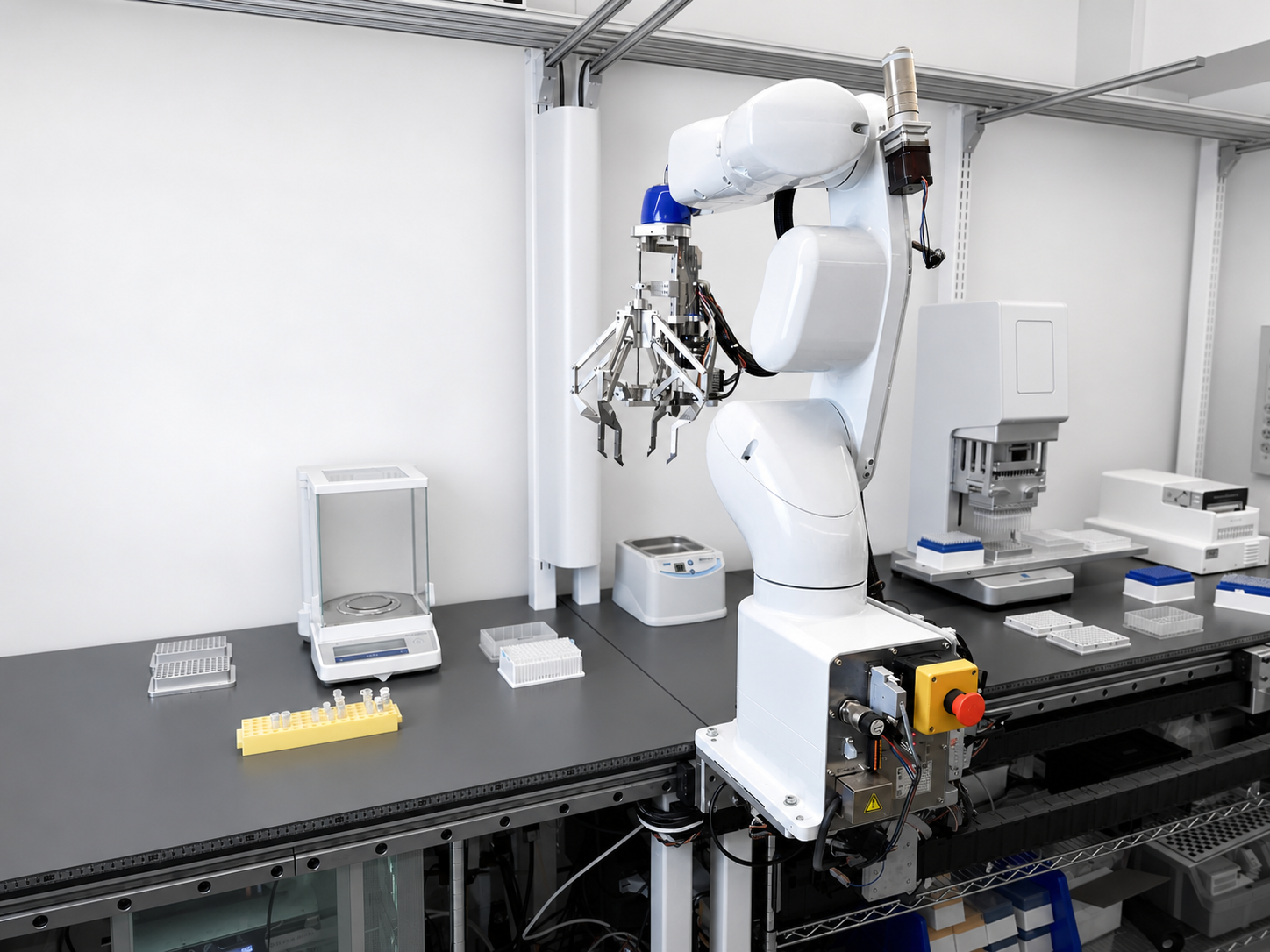
If your samples are sensitive, your protocols change often, or you need to watch and adjust a run in real time, the lab belongs in your lab.
In-lab physical AI keeps your science under your control: no shipping, no adapting to someone else's menu, and protocol changes are a sentence rather than a support ticket. What physical AI for the bench is →