A robot that physically moves between the instruments you already own — connecting every station — and, together with an orchestration layer, turns your bench into an autonomous, self-driving lab.
Glides along a rail to serve every station — no lab redesign.
Cameras confirm each transfer; errors are caught at the bench, not the reader.
Load once and the workflow repeats — load, run, unload — hands-free.
Robot on Rails and Red Queen Bio ran a real wet-lab molecular cloning protocol on the Undergrad — a 79× increase in cloning efficiency, measured on a real bench, not simulated.
Automation has always been able to repeat; it has never been able to perceive. The Undergrad sees the actual deck, understands the goal, and adapts to a real bench — instead of blindly replaying a script that assumes the world is perfect.
Most failed runs are silent handling errors — a missed tip pickup, a misaligned plate, an incomplete aspiration — found only later in the data. Onboard vision checks each step as it happens and flags or re-seats an exception mid-run, so a clean result means the steps actually happened.
The vision loop checks each atomic action against what it expects to see, so a problem is caught at the bench, not at the reader.
Because it verifies its own work, you can leave it running — and trust that a clean result means the steps actually happened.
Traditional automation is all body and no mind — it replays a fixed script and assumes the world is perfect. Physical AI joins the two: perception and reasoning that understand intent, driving a robot that acts and verifies on a real bench.
You describe the protocol the way you'd brief a colleague. The system interprets that intent into an executable plan, and onboard vision lets it perceive the actual deck — plates, tips, liquids — rather than assuming where everything is.
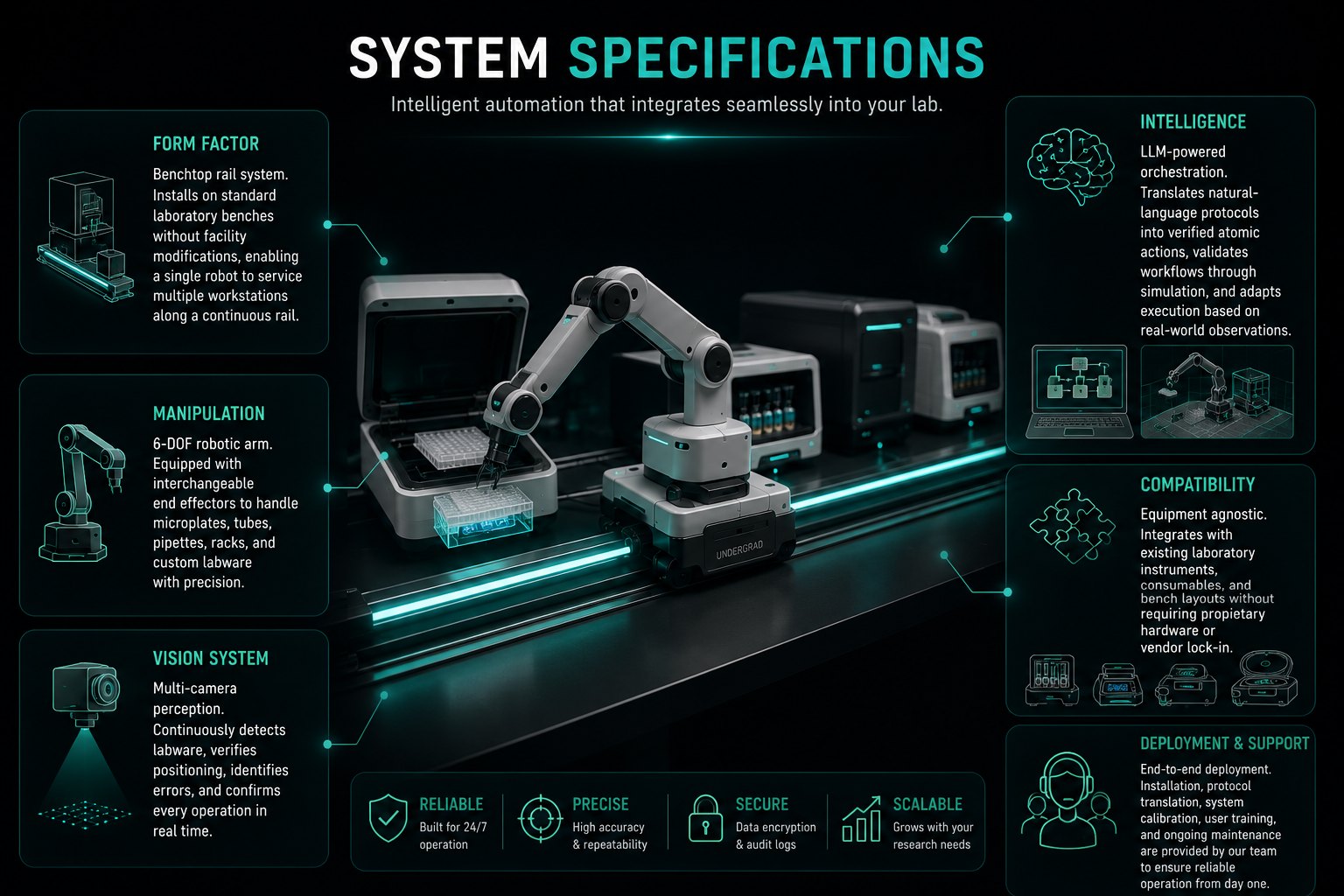
A precise rail-mounted robot operates on your existing bench and the instruments you already trust — thermocyclers, readers, magnets, the Accuris AutoMATE 96 — instead of replacing them or demanding a dedicated room.
You work at the top, in plain language. The system handles everything below — down to camera-verified motion.
Every run is training data. Doing the science is what makes the science get easier.
Intent records capture the goal; cameras capture ground truth; every re-seat and flag is labelled anomaly signal; and runs mirror into simulation so gains compound across every deployment — removing run-to-run variation so downstream differences reflect biology, not who pipetted that day.
Fixed automation gets faster at one task. The Undergrad gets broader — because perception and plain language are general, every new workflow is a description, not an integration project. Breadth is what compounds into depth.
Onboard vision lets it work on a real, unstructured deck — expanding what it can act on without re-engineering for every layout.
Plain-language understanding turns any described workflow into action — a new assay is a new sentence, not a new build.
Confirmed integration today: the Accuris AutoMATE 96.
A clear line separates your experimental IP from our system intelligence. We use what we learn to make your robot better — never to compete with your science or share what you've built.
What you build on the Undergrad belongs to you.
Readable, audit-ready records of every step — no opaque decisions.
Always-on support and iteration, in the lab with you.
Robot on Rails builds Physical AI Lab Operators. The Undergrad physically runs experimental protocols from plain-language instructions, vision-verified at every step, so scientists spend their time on science instead of repetitive bench work.
AI that doesn't just plan on a screen — it physically acts in the lab. It interprets a plain-language protocol, converts it into precise actions, and carries them out on real instruments with vision-guided verification.
No. You describe your protocol in plain language. The system converts it into atomic steps, simulates them for your review, then runs them physically — no scripting required.
Yes. The Undergrad is equipment-agnostic and installs on a standard bench without facility modification. It operates the instruments and labware you already use, with no vendor lock-in.
Robot on Rails delivered a 79× improvement on a molecular cloning protocol, validated with its customer Red Queen Bio. The company has reached $2M+ in revenue, bootstrapped, with a committed long-term contract with Red Queen Bio.
Bring physical AI to your existing instruments.
Book a demo Browse protocols