Beyond walk-away runs — the closed loop where experiments choose the next experiment.
The most meaningful version isn't a room with no people — it's a closed loop: AI proposes an experiment, automation runs it, the system reads the result, and that result chooses the next experiment. The point isn't to remove scientists; it's to compress the design–run–analyse cycle from weeks to hours so scientists iterate far faster on the questions that matter.
"Automated lab" spans a spectrum, and only the last one is genuinely transformative:
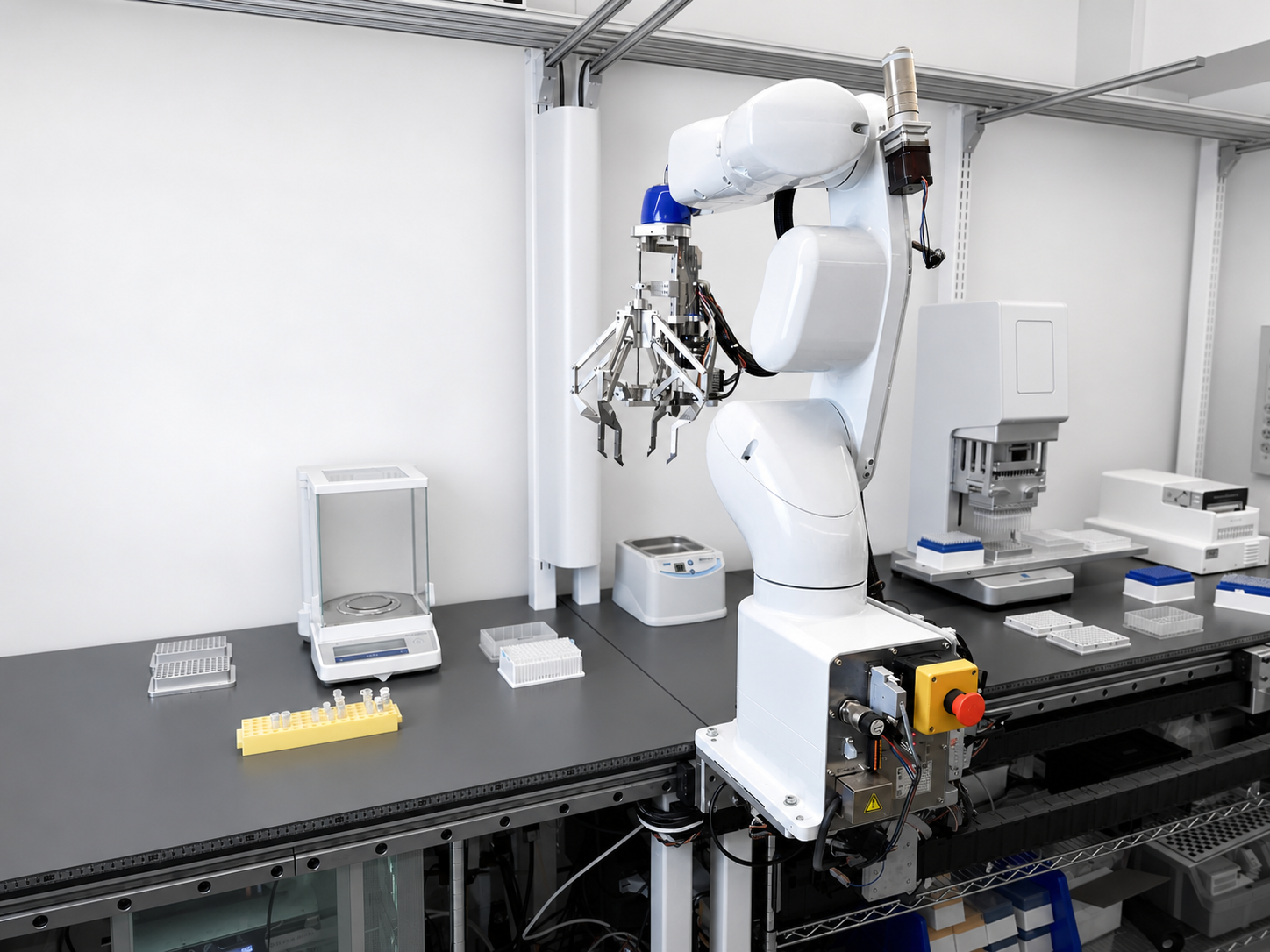
The fully-autonomous end of the spectrum already exists in narrow domains. In Nature (2023), an LLM-driven agent called Coscientist planned and executed real chemistry experiments end to end [A], and Berkeley's A-Lab ran for 17 days of hands-off operation, choosing and synthesising inorganic compounds with active learning [B] — although independent analysis later questioned some of A-Lab's novelty claims [C], a reminder that a closed loop still needs human verification.
The through-line: today's "fully automated" labs work when the goal, the tools, and the success signal are tightly bounded. Open-ended discovery — deciding which question is worth asking — remains human. That's why the practical target for most labs isn't a lights-out megalab but a self-driving bench you own, with every step vision-verified.
The interesting version runs a continuous cycle: propose → run → read → decide → repeat. AI proposes the next experiment, automation executes it, instruments read the result, and a model uses that result to pick what to try next — narrowing toward an answer without waiting for a human between every round.
The win isn't fewer people. It's a far shorter loop between idea and evidence.
Closed-loop "self-driving labs" are real in bounded settings. Berkeley's A-Lab ran for 17 days of continuous operation, using active learning to plan and interpret materials-synthesis experiments [1]. A GPT-4-driven system, Coscientist, autonomously designed and executed chemistry, including optimising reactions [2]. Both point at the same architecture — though A-Lab's results were later partly corrected, underscoring that the loop still needs human review.
The myth is the dark, empty lab. The reality is the opposite: scientists move up the stack — setting goals, designing the search space, interpreting surprises, and handling the novel work AI can't. The value created is iteration speed, not headcount removed. That's the same idea behind experimental compute: scale the number of real experiments without scaling hands-on time.