What today's AI can genuinely operate, what it still can't, and where the honest line sits.
Yes — for constrained, well-defined workflows. When the protocol, the tools, and the feedback signals are clearly specified, AI can plan, execute, and even optimise experiments on automated hardware; this has been demonstrated in peer-reviewed work. What it can't yet do reliably is the open-ended science — choosing novel targets, inventing new modalities, and setting research strategy. The honest summary: AI can run the experiment; humans still decide which experiment matters.
"Running a lab" bundles four very different jobs, and AI is far stronger at some than others:
This isn't hypothetical. In Nature (2023), a GPT-4-driven system called Coscientist autonomously designed, planned, and executed experiments — including optimising palladium-catalysed cross-coupling reactions — by combining literature search, code execution, and robotic APIs [1]. The same year, Berkeley's A-Lab ran for 17 days of continuous autonomous operation and reported synthesising dozens of new inorganic compounds from targets identified with the Materials Project and Google DeepMind [2].
One honest caveat: A-Lab's novelty claims were later questioned by independent analysis and the paper was corrected [3] — a useful reminder that "autonomous" output still needs human scrutiny.
Every one of those successes shares a trait: a well-bounded problem with clear success signals. The hard, unsolved part is everything upstream — deciding which question is worth asking, choosing a novel target or modality, and diagnosing an ambiguous failure that doesn't match any expected pattern. That judgment still sits with scientists.
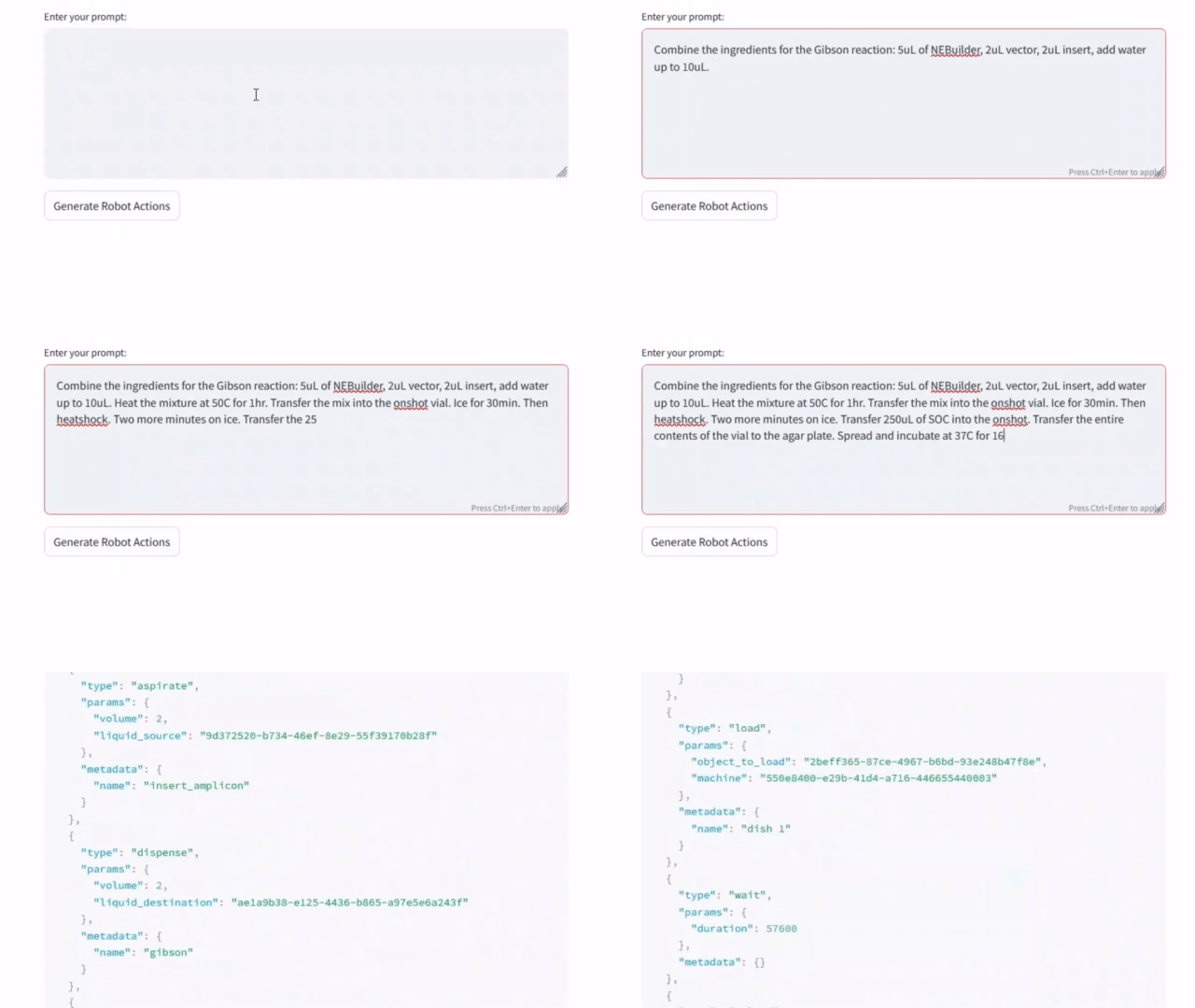
The reliable model today is constrained autonomy with human oversight: a person sets the goal and the boundaries, AI plans and runs the experiment on real hardware with verification at each step, and a person reviews the result and decides what's next. On the Undergrad, that's exactly the shape — you describe the protocol in plain language, the robot executes it vision-verified, and you stay in charge of the science. See how that works →
The reason "AI ran the experiment" isn't enough on its own: science already has a trust problem. In a landmark Nature survey of 1,576 researchers, most could not reproduce experiments — other people's or their own [4].
Autonomy only helps if every step is logged and vision-verified — so a clean result means the steps actually happened. That is the difference between a robot that replays a script and one whose output you can trust.