Robot on Rails builds physical AI for the lab bench — removing the physical bottlenecks of experimentation so scientists can focus on discovery. No code. No lab redesign. Just research.
AI now generates more hypotheses than humans can ever test. There are 48 billion synthesizable drug-like molecules, but only about 2 million are tested in a wet lab each year. The gap isn't discovery — it's at the bench, where scientists still pipette by hand, load instruments manually, and spend more time on logistics than on science.
We started Robot on Rails to change that with physical AI — a robot that works alongside scientists at the bench, runs their protocols, and gives their time back to the work only they can do.
We turn a lab's islands of instruments into one autonomous lab — so scientists are free to focus on discovery, not logistics.
Every instrument on your bench. One rail. One robot.
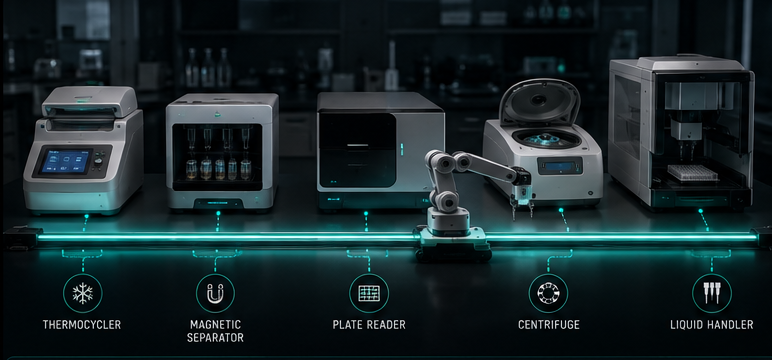
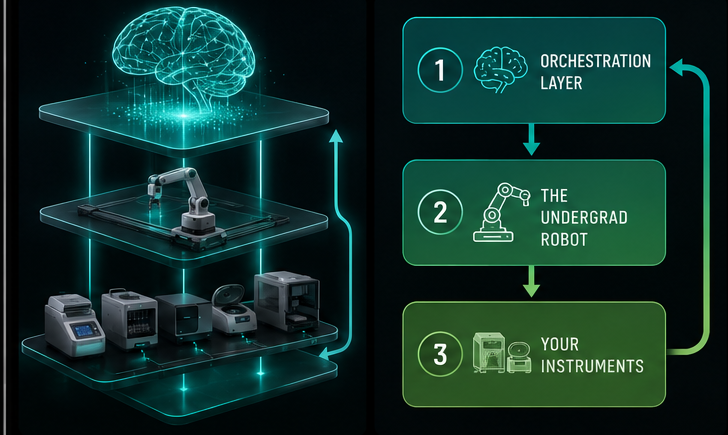
Three layers: orchestration → robot → your instruments.
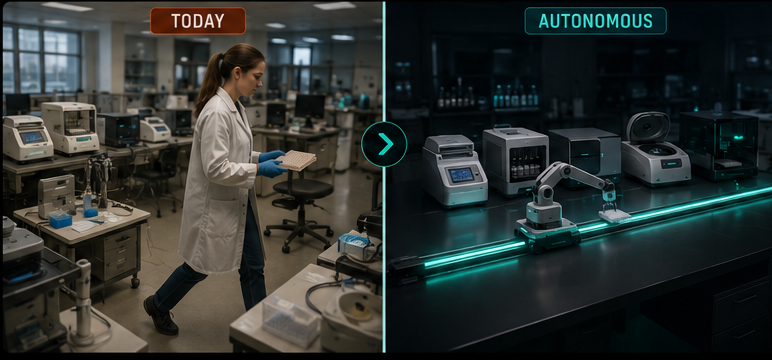
From a lab you operate to a lab that operates itself.
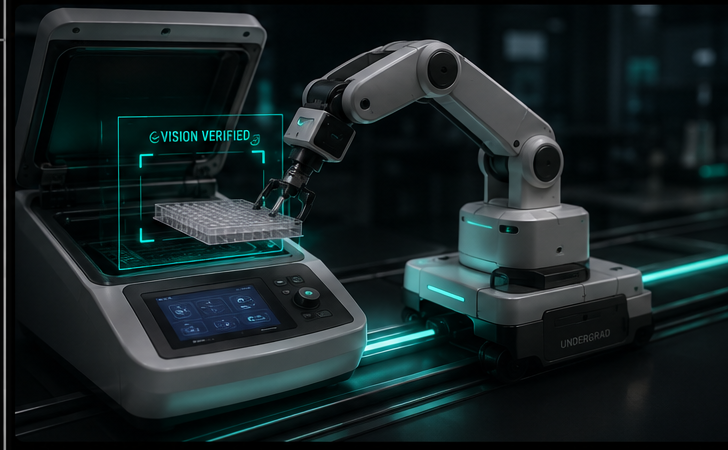
Our robot, the Undergrad, pairs an AI that understands plain-language science with a body that sees what it's doing — running protocols on the instruments you already own, and getting better with every run.
Describe a protocol the way you'd brief a labmate. No scripting, no automation engineer.
Onboard cameras confirm every step on a real bench — errors are caught at the bench, not the reader.
Every run is training data. The longer you use it, the more it works the way you think.
In software, to test a hundred models you spin up instances. We bring the same elasticity to the bench: send the order, the robot runs the experiments, and you get real physical data back — not just a simulation. This is the operating system for physical experimentation, in a market that's barely been automated.
In software, testing 100 models means spinning up instances. We bring that elasticity to the bench: send the order, the robot runs the experiments, and you get real physical data back. This is the operating system for physical experimentation — a $109B market that's barely been automated.
If you're interested in the future of lab automation, we'd love to connect — investing@robotonrails.com.
Robot on Rails is a small, deliberate team spanning precision robotics, computer vision, and bioprocess science — incubated in the New England robotics ecosystem out of MassRobotics, with real IP and early instrument partners behind us. Meet the team →
Whether you're buying a robot, exploring a collaboration, or just curious — we'd love to hear from you.
Talk to us Meet the team